How the Sun, Earth and Moon Work: A Guide for Kids and Parents
The Moon seems to change shape because we see different amounts of its sunny side as it travels around Earth. Day and night happen because Earth spins. Seasons happen because Earth is tilted. This guide explains each one simply, and gives you things to try in the free 3D explorer, which shows where the Sun, Earth and Moon really are for any date.
Updated · Published by 369s.in
Why does the Moon change shape?
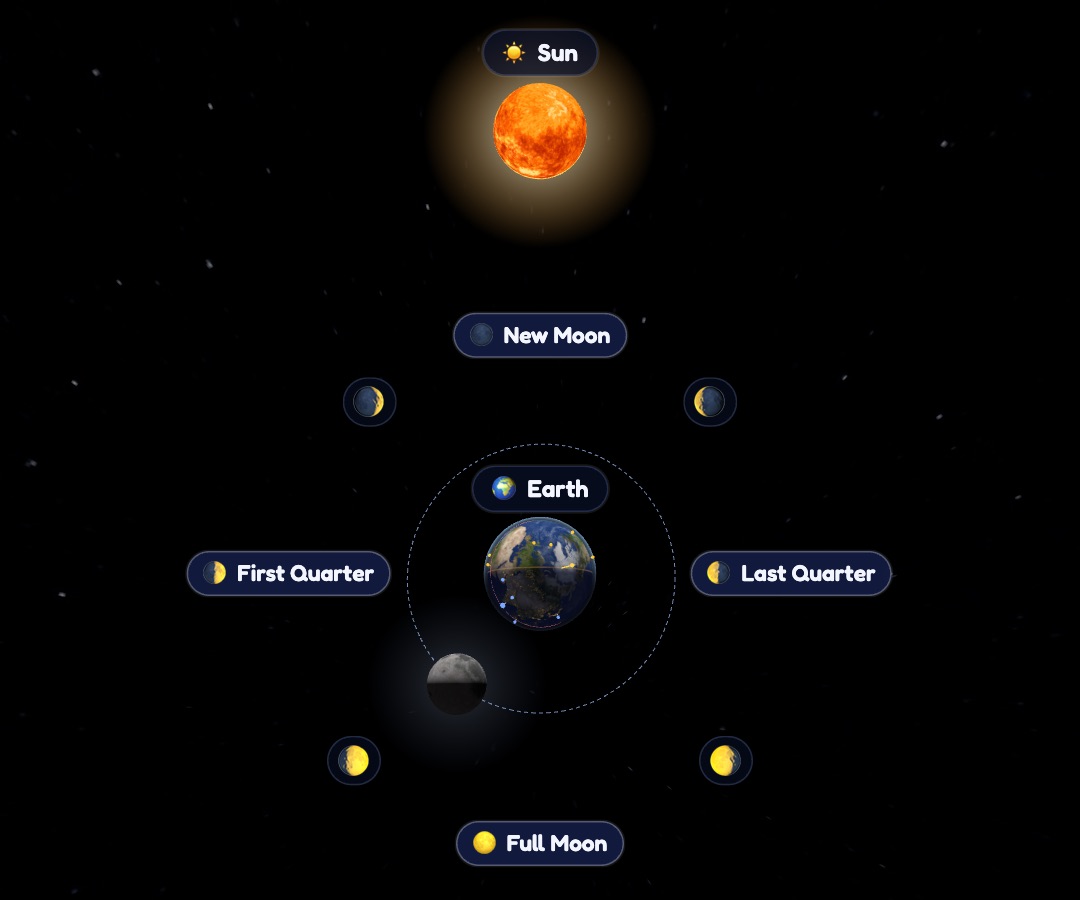
The Moon doesn't really change shape. Half of the Moon is always lit by the Sun, just like half of Earth always has daytime. The Moon travels around Earth about once every 29.5 days. As it moves, we see different amounts of its sunlit half, so it looks like it grows and shrinks.
- New Moon: the Moon is between Earth and the Sun. Its sunny side faces away from us, so we can't see it.
- Full Moon: the Moon is on the far side of Earth from the Sun. We see its whole sunny side.
- In between: we see part of the sunny side, a crescent, a half or a gibbous (more than half) Moon.
What are the 8 phases of the Moon?
The Moon goes through eight named phases each month. "Waxing" means the lit part is growing. "Waning" means it is shrinking.
| Phase | What you see | Best time to look |
|---|---|---|
| 🌑 New Moon | Nothing, the dark side faces us | Not visible; it is near the Sun |
| 🌒 Waxing Crescent | A thin sliver that grows each night | Evening, low in the west after sunset |
| 🌓 First Quarter | Half the Moon is lit | Afternoon and evening; sets around midnight |
| 🌔 Waxing Gibbous | More than half, still growing | Evening and most of the night |
| 🌕 Full Moon | The whole face is lit | All night; rises at sunset, sets at sunrise |
| 🌖 Waning Gibbous | More than half, shrinking | Late night and morning |
| 🌗 Last Quarter | The other half is lit | Rises around midnight; visible in the morning |
| 🌘 Waning Crescent | A thin sliver that shrinks | Early morning, low in the east before sunrise |
🔄 The emoji show the Moon as seen from the northern half of the world. In the southern half, including Australia, South Africa and most of South America, the Moon looks flipped, so a waxing Moon is lit on the left.
Upcoming main phases (times in UTC): 🌕 Full Moon 26 September 2026, 🌗 Last Quarter 3 October, 🌑 New Moon 10 October, 🌓 First Quarter 18 October, 🌕 Full Moon 26 October. The explorer's Moon calendar shows these in your own time zone.
Why do we have day and night?
Earth spins around once every 24 hours. The Sun can only light the half of Earth that faces it, so that half has day. The other half faces dark space and has night. Earth turns toward the east, so the Sun seems to rise in the east and set in the west as your home turns into the sunlight and back out of it.
That's why it is a different time of day around the world. When children in India are eating lunch, children in New York are fast asleep.
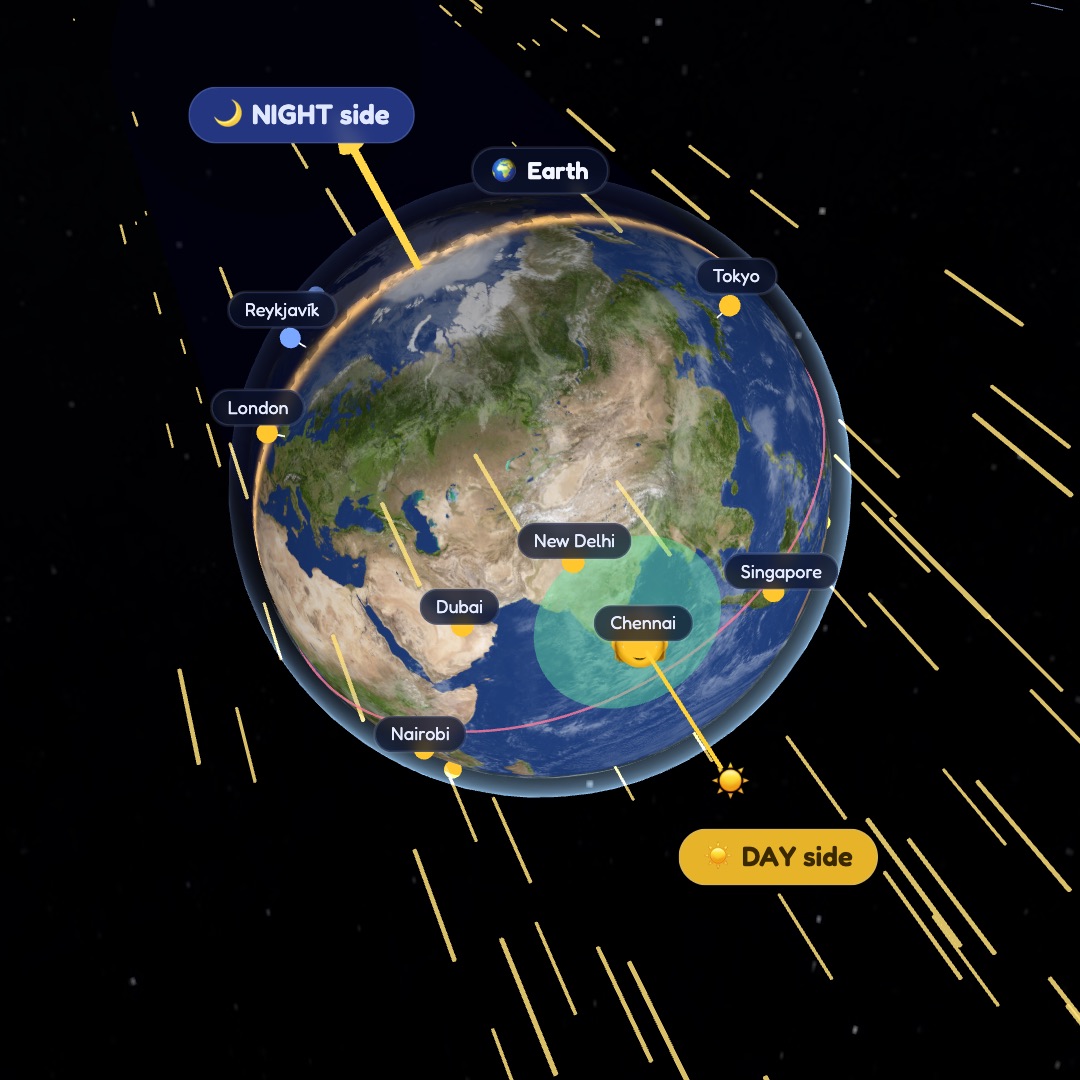
The glowing line between day and night is called the terminator. Everyone standing on it is seeing a sunrise or a sunset.
Why do we have seasons?
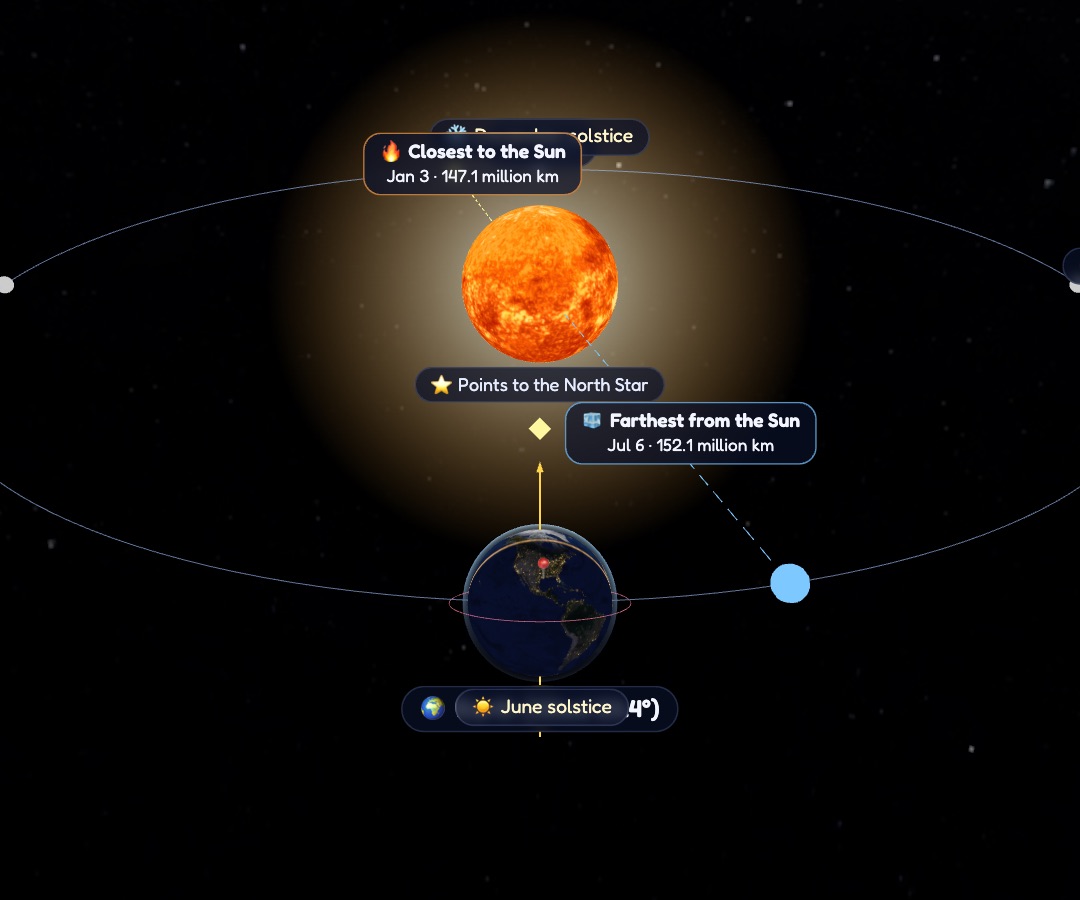
Seasons happen because Earth is tilted. Earth's axis leans about 23.4° and always points the same way in space, toward the North Star. As Earth travels around the Sun over a year, first one half and then the other leans toward the Sun.
- Leaning toward the Sun: the Sun climbs high in the sky and days are long. It is summer.
- Leaning away from the Sun: the Sun stays low and days are short. It is winter.
- In between: spring and autumn, when day and night are close to equal. That's around the equinoxes, 20 March and 23 September 2026.
A common mistake: seasons are not caused by Earth getting closer to the Sun. Earth's path is a very slightly squashed oval. It is closest to the Sun in early January (about 147.1 million km) and farthest in early July (about 152.1 million km). That's why it is summer in Australia while it is winter in Europe. Near the equator, day length hardly changes: in Chennai, days stay between about 11½ and 12¾ hours all year.
How big and how far away are the Sun, Earth and Moon?
| Real size or distance | To picture it | |
|---|---|---|
| 🌍 Earth's width | 12,742 km | Our home |
| 🌙 Moon's width | 3,474 km | About a quarter of Earth's width |
| ☀️ Sun's width | About 1.39 million km | About 109 Earths side by side |
| Earth to Moon | 384,400 km on average | About 30 Earths in a row; moonlight takes 1.3 seconds to reach us |
| Earth to Sun | About 150 million km | About 390 times farther than the Moon; sunlight takes about 8 minutes 20 seconds |
Because space is so big, the explorer draws the Sun and Moon closer and bigger than they really are, but always in the right direction. Turn on "📏 Real distances" in the 👁️ menu to see how far away the Moon really is.
Is the 3D explorer accurate?
Yes, for positions, phases and times. The explorer calculates where the Sun and Moon are using Astronomy Engine, an open-source astronomy library that is accurate to a small fraction of a degree. The day/night line, Moon phases, sunrise and sunset times, and equinox and solstice dates all come from those calculations. Automated tests check them against real events, such as the total solar eclipse on 12 August 2026 (a New Moon) and the total lunar eclipse on 3 March 2026 (a Full Moon).
What isn't to scale: the sizes of the Sun and Moon and their distances are squeezed so everything fits on screen. City clocks use each city's real time zone, including daylight saving.
Things to try in the explorer
- Watch one Moon month in 30 seconds. Open the 🔭 view playing one day per second and watch the Moon's lit side as it goes around Earth.
- Find tonight's Moon. Open the explorer; the Moon panel shows today's phase, how much is lit, and moonrise and moonset where you live.
- Why is it night for your cousins? Pick your city and another city far away, then press 💡 Why day & night?
- Be the planet. Press 🌍 Spin Earth and drag the globe sideways. The clock moves as Earth turns.
- Compare June and December. Open Seasons on the June solstice and the December solstice, and watch the daylight hours change.
- See a real Full Moon. Jump to the Full Moon on 26 September 2026: the Moon is on the far side of Earth from the Sun.
Questions kids ask
Why do we always see the same side of the Moon?
The Moon spins exactly once for every trip it makes around Earth, so the same side always faces us. Scientists call this tidal locking.
Why can we sometimes see the Moon in the daytime?
The Moon is above the horizon for about half of every day, and that time moves later each day. Around the first and last quarter phases, the Moon is often up in the afternoon or morning while the Sun is still shining.
Does the Moon make its own light?
No. The Moon shines because sunlight bounces off it, the same way a ball glows when you shine a torch on it.
Is the explorer free? What ages is it for?
It's free, with no sign-up, and works in any modern browser on phones, tablets and computers. It's made for kids aged about 6 to 12, but curious grown-ups love it too.
Sources
- NASA Science: Moon Phases
- NASA Science: Moon Facts
- NASA Space Place: What Causes the Seasons?
- NASA Space Place: How Long Is One Day on Other Planets?
- Astronomy Engine (positions, phases and season dates)